Xinhua
05 Aug 2025, 08:16 GMT+10
GUANGZHOU, Aug. 5 (Xinhua) -- The morning light gently broke, casting a glow over clouds that billowed like snow-capped mountains, while the crowing of roosters added a serene touch to the dawn at a lightning research base, where scientists wrestle with Mother Nature's most thunderous event.
Zhu Wei, a graduate student working at this base in the wilderness of Leizhou, south China's Guangdong Province, began his morning routine just like the rest of the team -- checking atmospheric data curves and radar echo maps to predict whether or not distant clouds would bring thunderstorms.
"Thunderclouds will pass here in an hour and a half!" Wang Jianguo, the head of the lightning research base, called out. His words rang like an order, jolting the entire team into action, which saw them hurrying to their respective observation chambers and devices.
They are a team of lightning chasers associated with the Engineering Research Center for Lightning Protection and Grounding Technology at Wuhan University in central China's Hubei Province. Their quest, harking back to that of Benjamin Franklin centuries ago, symbolizes humanity's ceaseless efforts to understand two formidable forces of nature -- thunder and lightning.
Leizhou, where the team conducts triggered lightning experiments, literally means Thunder City. As the name suggests, it experiences many thunderstorm days -- over 90 a year.
Currently, most lightning research is conducted through laboratory discharge simulations. However, a rocket-triggered lightning experiment, carried out in the "laboratory" of Mother Nature, provides more accurate data due to the natural experimental environment. Given the very unpredictable nature of lightning, conducting such real-life experiments is no easy task.
As the dark clouds approached and the rain intensified -- team members were ready and waiting at their observation posts. Notably, this process of triggering lightning felt like a relay race for the more than ten sun-baked faculty members and students at the base.
"Power on! Get into position quickly!" Li Quanxin, an associate researcher, called out. Li and Zhu had rushed to a cabin located a kilometer away, where they were poised to measure the electromagnetic, acoustic and optical parameters of coming lightning strikes.
The center features six launch towers and hundreds of precision instruments, which are only activated just before launching.
Thunderstorms typically last only 20 to 30 minutes -- which requires everyone to get into position within ten minutes after observing the storm's approach.
Thanks to thorough training, preparation time at this base has been reduced from an initial 15 minutes to 8 minutes and 30 seconds. Zhang Li, a graduate student responsible for overvoltage monitoring devices in five different positions, even timed his running down to the second and mapped out the fastest possible route.
In the launch chamber, when the data curve on the monitoring platform spiked, everyone held their breath. "All teams, attention! The atmospheric electric fields have reached the threshold. Prepare for launch!" commanded postdoctoral researcher Cao Jinxin over the intercom.
"5, 4, 3, 2, 1, launch!"
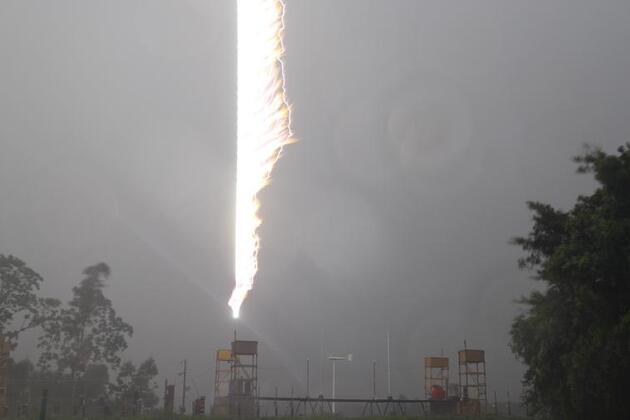
A long "whoosh" was heard as the rocket soared into the air. A few seconds later, a flash of lightning streaked across the sky, followed by a loud rumble of thunder.
"The lightning struck right in front of me, and the dark sky instantly lit up like it was daytime," recalled Zhu, beaming with excitement.
Cheers, screams and applause filled the launch cabin, but moments later, everyone returned to intense focus. The launches continued.
Altogether, six successful launches out of six attempts for the day were achieved. This marked the second successful lightning-triggering event since the team was stationed at the base two months ago, just ahead of the thunderstorm season.
What exactly is the purpose of such lightning experiments, you may ask. Wang explained it by using the wind power sector as an example. Wind turbines are typically located on coastlines, hillsides and even offshore, where there are few lightning receptors, making them susceptible to lightning strikes. As the equipment for large wind turbines is quite expensive, any damage from lightning can result in significant repair costs and extended downtime.
The base installed a small wind turbine last year to carry out lightning strike experiments. The team aimed to strike the turbine with lightning while it was operational to verify whether the blade and power cable system could withstand the force.
Lightning triggered by rockets closely resembles natural lightning. The research findings from these experiments will offer valuable insights for implementing protective measures on engineering facilities, Wang said.
The team has built the base from the ground up since 2022. Despite the challenges they have faced on this pioneering journey, and the constant vigilance required to accurately anticipate the unpredictable lightning, with the team often waiting in vain -- no one has wavered in their commitment to this project.
"Since I began working at the center, I have truly come to understand what it means to contribute to the development of our homeland," said Zhou Fangjia, a graduate student. "It no longer feels like a distant promise."
Get a daily dose of Hong Kong Herald news through our daily email, its complimentary and keeps you fully up to date with world and business news as well.
Publish news of your business, community or sports group, personnel appointments, major event and more by submitting a news release to Hong Kong Herald.
More InformationWASHINGTON, D.C.: With the clock ticking toward a self-imposed trade deal deadline, U.S. President Donald Trump has announced steep...
MOSCOW, Russia: One of the most powerful earthquakes ever recorded — measuring 8.8 in magnitude — struck off the remote coast of Russia's...
BEIJING/SHANGHAI/NEW YORK: Nvidia has placed an order for 300,000 more H20 chips with contract manufacturer TSMC, two sources told...
HONG KONG: CK Hutchison is exploring the inclusion of a major Chinese investor in the proposed US$22.8 billion sale of its global ports...
GUANGZHOU, Aug. 5 (Xinhua) -- The morning light gently broke, casting a glow over clouds that billowed like snow-capped mountains,...
DHAKA, Aug. 5 (Xinhua) -- In Tangail district, located in central Bangladesh, the pineapple industry is thriving. Recognized as a...
NEW YORK, New York - U.S. stocks rebounded Monday with all the major indices pushing higher. Markets were boosted by Europe putting...
NEW YORK CITY, New York: American Eagle Outfitters, a popular U.S. clothing brand, wanted to grab attention with its new fall advertising...
WASHINGTON, D.C.: The U.S. labor market lost momentum in July, with job growth slowing more than expected and major downward revisions...
SAN FRANCISCO, California: Apple projected stronger-than-expected revenue for the current quarter ending in September, helping lift...
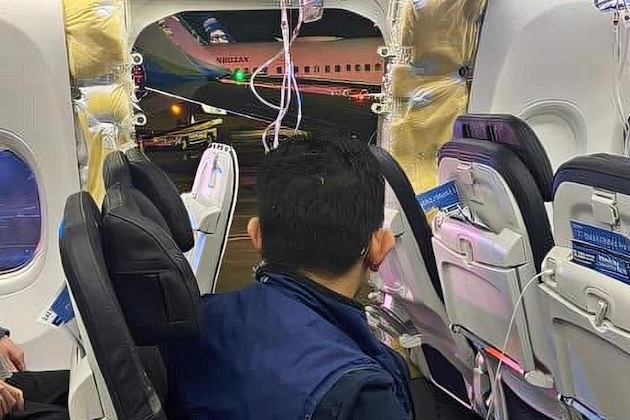
SEATTLE, Washington: More than a year after a door panel ripped off a Boeing 737 MAX 9 mid-flight, four flight attendants who were...
SEATTLE, Washington: Starbucks expressed confidence this week that a combination of streamlined store operations and new menu offerings—such...