RT.com
27 Jul 2025, 17:45 GMT+10
At the SCO summit, Iran laid the groundwork for a Eurasian security bloc and the West panicked
What if the next global security pact wasn't forged in Brussels or Washington - but in Beijing, with Iran at the table?
This is no longer a theoretical question. At the mid-July meeting of the Shanghai Cooperation Organization (SCO) Council of Foreign Ministers in China, Iran made it clear: Tehran now views the SCO not just as a regional forum, but as a potential counterweight to NATO. In doing so, it signaled a profound strategic pivot - away from an outdated Western-dominated system and toward an emerging Eurasian order.
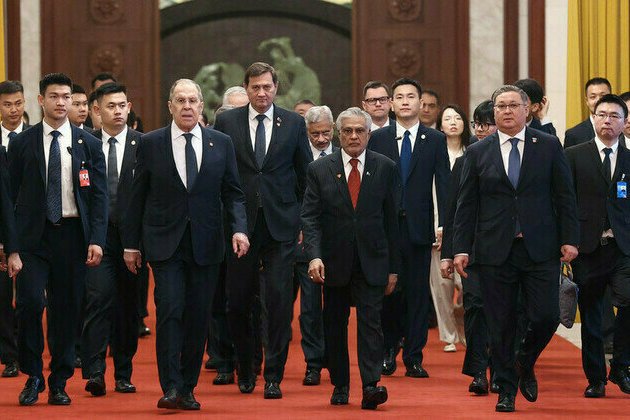
The summit highlighted the increasing resilience of multilateral Eurasian cooperation in the face of growing global turbulence. Russia was represented by Foreign Minister Sergey Lavrov, who also met with Chinese leader Xi Jinping - an encounter that underscored the strength of the Moscow-Beijing axis. On the sidelines, Lavrov held bilateral meetings with the foreign ministers of China, Pakistan, India, and notably, Iran. His talks with Iranian Foreign Minister Abbas Araghchi focused on diplomatic solutions to the nuclear issue and emphasized deepening strategic coordination.
The Iranian side used the platform with purpose. Araghchi expressed his appreciation for the SCO's solidarity amid Israeli aggression and stressed that Iran views the organization not as symbolic, but as a practical mechanism for regional unity and global positioning.
India's full participation also contradicted predictions in Western circles that geopolitical tensions would paralyze the SCO. Instead, New Delhi reaffirmed its commitment to the platform. The implication is clear: unlike NATO, where unity depends on compliance with a central authority, the SCO has proven flexible enough to accommodate diverse interests while building consensus.
For Russia, the SCO remains a cornerstone of its Eurasian strategy. Moscow serves as a balancing force - linking China with South and Central Asia, and now, with an assertive Iran. Russia's approach is pragmatic, multi-vector, and geared toward creating a new geopolitical equilibrium.
The heart of the summit was Abbas Araghchi's speech - an assertive and legally grounded critique of Israeli and American actions. He cited Article 2, Section 4 of the UN Charter, denounced attacks on Iran's IAEA-monitored nuclear facilities, and invoked Resolution 487 of the UN Security Council. His message: Western aggression has no legal cover, and no amount of narrative control can change that.
But beyond condemnation, Araghchi delivered a concrete roadmap to strengthen the SCO as a vehicle for collective security and sovereignty:
A collective security bodyto respond to external aggression, sabotage, and terrorism
A permanent coordination mechanismfor documenting and countering subversive acts
A Center for Sanctions Resistance, to shield member economies from unilateral Western measures
A Shanghai Security Forumfor defense and intelligence coordination
Enhanced cultural and media cooperationto counter cognitive and information warfare
These are not rhetorical gestures - they are blueprints for institutional transformation. Iran is operationalizing a new security doctrine built on multipolarity, mutual defense, and resistance to hybrid threats.
While NATO is structured around a rigid hierarchy dominated by Washington, the SCO embodies a post-hegemonic vision: sovereignty, equality, and civilizational plurality. Its member states represent over 40% of the global population, possess vast industrial capacities, and share a collective desire to break the unipolar mold.
Tehran's bet is clear: the SCO offers not just a geopolitical shelter, but a platform for advancing a new global logic - one rooted in strategic autonomy, not dependency.
The sophistication and clarity of Araghchi's initiatives suggest that Tehran is preparing for the long game. Behind closed doors, the summit likely featured discussions - formal and informal - about deepening SCO institutionalism, perhaps even rethinking the organization's mandate.
Araghchi made that vision explicit: "The SCO is gradually strengthening its position on the world stage... It must adopt a more active, independent, and structured role." That's diplomatic code for institutional realignment.
The Western response was immediate. Within days of Iran's proposals, the EU imposed new sanctions on eight individuals and one Iranian organization - citing vague claims of "serious human rights violations." Israel, by contrast, faced no new penalties.
It is geopolitical signaling. Tehran's push to turn the SCO into an action-oriented bloc is seen in Brussels and Washington as a direct threat to the current order. The more coherent and proactive the SCO becomes, the harsher the pressure will grow.
But that pressure proves Iran's point. The rules-based order is no longer rules-based - it is power-based. For countries like Iran, the only path to sovereignty is through multilateral defiance and integration on their own terms.
Iran is not improvising. It is positioning itself as a co-architect of a post-Western security order. Its vision for the SCO goes beyond survival - it is about shaping an international system where no single bloc can dominate through sanctions, information warfare, or coercive diplomacy.
This strategy has implications far beyond Tehran. If the SCO embraces Iran's proposals and begins to institutionalize them, we could be witnessing the early formation of the 21st-century's first true alternative to NATO.
The West may dismiss this as fantasy - but in Eurasia, the future is already being drafted. And this time, it's not happening in English.
(RT.com)
Get a daily dose of Hong Kong Herald news through our daily email, its complimentary and keeps you fully up to date with world and business news as well.
Publish news of your business, community or sports group, personnel appointments, major event and more by submitting a news release to Hong Kong Herald.
More InformationWASHINGTON, D.C.: This week, President Donald Trump unveiled a new trade framework with Japan, announcing a 15 percent tariff on goods...

SHANGHAI, China: A leading Chinese automotive industry publication has walked back claims that regulators plan to ban the resale of...
At the SCO summit, Iran laid the groundwork for a Eurasian security bloc and the West panicked What if the next global security pact...
Taipei [Taiwan], July 27 (ANI): Taiwan has expressed deep appreciation to senior ministers from Australia and the United Kingdom for...
Taipei [Taiwan], July 27 (ANI): The United States has, for the first time, overtaken China and Hong Kong in 2024 to become the largest...
(250727) -- BEIJING, July 27, 2025 (Xinhua) -- Children perform at an event marking the first anniversary of the successful inscription...
NEW YORK CITY, New York: As cannabis-infused drinks grow in popularity and take over retail shelf space once dominated by beer and...
NEW YORK CITY, New York: Goldman Sachs is hitting pause on plans for additional job cuts, following a stronger-than-expected rebound...
SEOUL, South Korea: With just days left before a 25 percent tariff deadline, South Korea's push to strike a trade deal with the United...
NEW DELHI/LONDON: India and the United Kingdom will sign a comprehensive free trade agreement on July 24 during Prime Minister Narendra...
NEW YORK, New York - U.S. stock markets made solid ground Friday, sending all the key indices out with weekly gains. The Standard and...
WASHINGTON, D.C.: This week, President Donald Trump unveiled a new trade framework with Japan, announcing a 15 percent tariff on goods...